Black Marble and a 737

Among domestic flag carrier airline crews, there is little greater prestige than being assigned to operate, work, and passenger schmooze through an oceanic crossing. The lower the flight number, the more expansive (and expensive) the internal cabin will be, with grating revenue managers in cubicles from Atlanta to Chicago and Seattle designating these flights as characteristic of the airline’s best service and also its highest margins. Name a so-called world city plus your airline of choice and chances are it’ll be a two or maybe even one-digit flight number.

And the US is home to a handful of world cities, the number of which is up for infinite ear-straining, synapse-frying debate. But the merits of New York City and Los Angeles as globe-defining cities are cemented, no matter what hundreds of thousands of pages of indictment-worthy Twitter, Reddit, and Facebook discussions espouse. As a result, frequent air shuttle service between these two cultural arenas is similarly important and arguably more operationally demanding than coordinating a North Atlantic tracked, Engines-Turn-Or-People-Swim flight release.

These domestic flights receive priority for most everything and often operate with widebody aircraft, premier cabin designs, and even food service. Shocking for those of us who sit behind the wing, right? This isn’t inherently unfair, though, as airlines (not their employees) are in it for the money alone. But if you’re a transplanted, up-to-nothing, big city-dweller flying back to your medium or small-sized hometown, it sure feels that way.

Fly back to the Capital of California (I do love a good float down the American River) from Newark and you’ll get the picture. A three-decade-old, hatchback of a 737-700 with (god forbid) no screens and a sheet’s worth of inoperative stickers will be flying you 2500 nautical miles at a pilot-degrading, passenger-unknowing crawl of Mach 0.78. The same rings true for half-note-worthy transcontinental destinations like Portland, Oregon, or Albuquerque, New Mexico, where airline cost and scheduling indexes only add up with more junior crews, older tail numbers, and circadian rhythm-challenging block times.

So what if your flight to Boise gets delayed? It’s not like you—one class of paying passenger—are the same as LAX or SFO-bound passengers, at least not to the Ed Bastians and Scott Kirbys of the world. And how come LAX-JFK and LAX-EWR leave on time when LAX-BDL is delayed by five hours? Well, more important people are going to New York, of course. 

But there is some solace to be had, for those of you recollecting on the feeling of terminal chairs against your overnighted tailbone as well as for those wondering why you’re reading this in a music publication. And it comes from Brooklyn, sort of.  

With an album cover reminiscent of searching for shapes in the sky on a red-eye night, you might think that Black Marble’s leading LP is fit for darkness, and you’d be right only in the literal. It might not be long enough to last you the entire 150-knot winter headwind, East-to-West flight time of six hours, but it is long enough for a climb to FL320 and for your crew of two upfront to check in with Cleveland Center. No matter your rude, mysterious, or simply asleep seatmates, A Different Arrangement is the ethos of red eye, transcon flying to nowhere in particular. I would know, too, as I’ve ridden from Kennedy or Liberty to PDX more times than I can count now, and almost always at night.

In what is almost certainly an insult to Chris Stewart and Ty Kube, there is no need to start with the opening track Cruel Summer, though proper listening from top to bottom does nothing but enhance the genius of this record. 80s-style space exploration synthesizers blend with incessant but gentle drums on every track, creating a sensory drowning that ends only with a touch of the screen. Set the album to a mechanical loop and you’ll fall in and out of consciousness independently of your human wants, as muzzled, incomprehensible vocals flow together as if it were one hour-long lyric. 
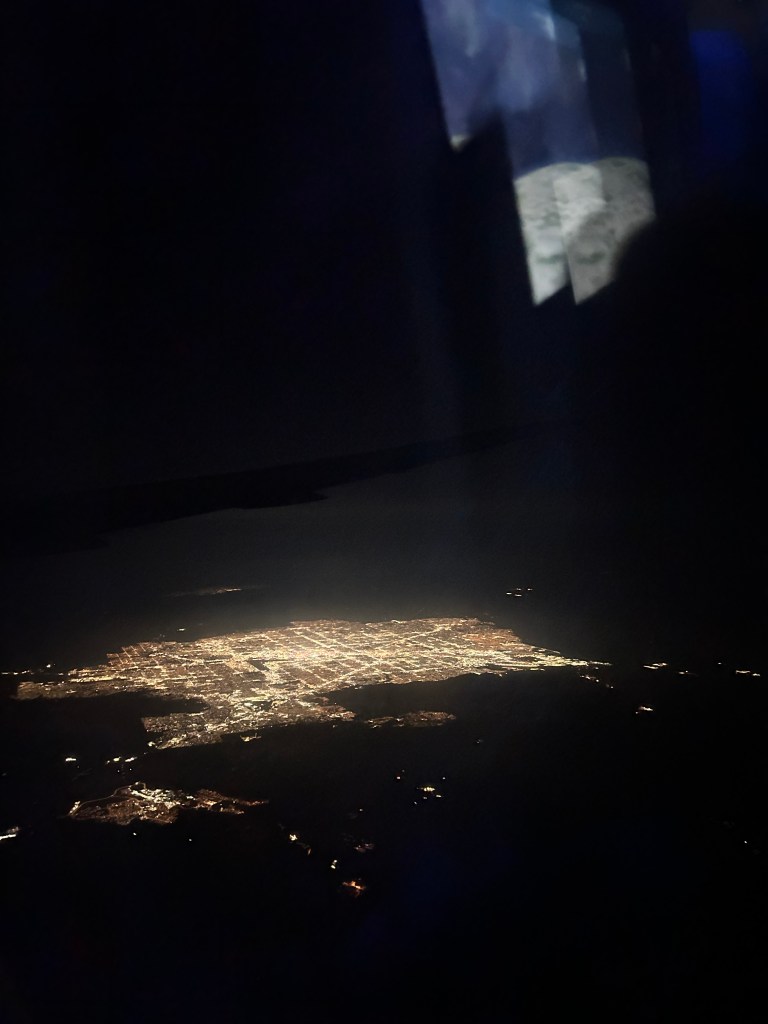
Identifying sizable metropolitan areas from six miles high is no real feat or even excitement, especially when you yourself aren’t stopping there. But a sole light amongst complete darkness begs a flow of wonder, unlike anything in most of our adult lives, as the quadruple-hit snare drum on Safe Minds matches the swaying fuselage yaw against crossing winds. You’re pushed down into your seat as the autopilot corrects to its set altitude by a margin of tens of feet and the metallic rapidity of bass on Static re-confirms that you’re traversing the sky while others drive and eat and sleep on the ground. 

Coming back to New York, the speed feels true and is egged on by the droning, almost whining synths on Pretender, as the flight tracker shows a ground speed approaching 700 mph. Faster than most achieve anywhere else on earth. There is nobody to catch but it damn sure feels like we’re after something, as the sun rises against a closed-window cabin. The person in front of me cracks a window and films a timelapse of the pink and orange wisps as I, a person with much less motivation, appreciate it for storage and recollection down the line. 

The cult-like applause beat of MSQ No-Extra is like that of every nervous flier, quietly clapping as everything goes according to the FAA-approved, dispatch-reviewed, pilot-certified flight plan on the commotionless journey. There is much to celebrate as the main gears impact the thousand-foot markers and the speed brakes pop—being alive and arriving for the passengers and being done for the flight crew. Sleep will soon arrive for the randomly selected bunch of employees whose job it was to watch over a cabin full of sweaty straphangers all night, and maybe they’ll listen to Last as its slow-moving melody begins winding down the album and their own unorthodox shift.

Truth be told, I would read the Mother Jones review of Black Marble’s first real album if I wanted a true music review. And I didn’t quite grasp seeing Black Marble in person, as my attendance at their Knockdown Center show many falls put a face and a much too present voice to what was previously a nebulous, confined echo chamber reserved for marveling in the administrative and all-too-real wonders of commercial flight. But next time you board a flight where the mood is sleepy if not somber and the destination is liminal for mental or geographic reasons, where your mind goes as this album plays won’t be scared or frustrated or even sad. It’ll just wander. 

Ode to 1st Avenue

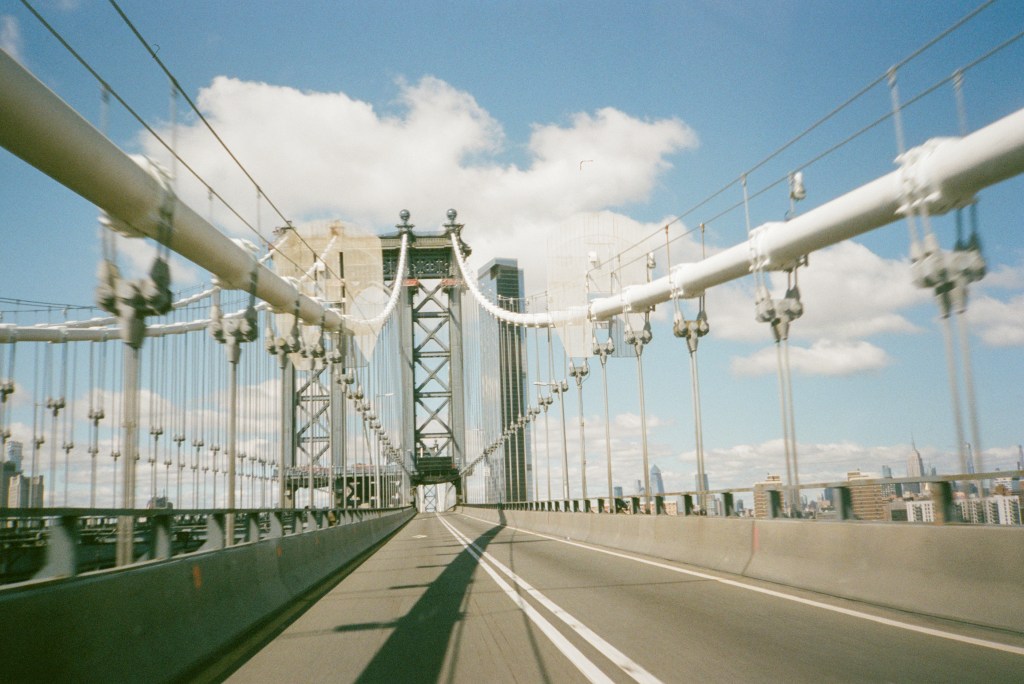
“A sliver of Manhattan bounded by Houston Street, First Street, and First Avenue, Peretz Square marks the spot where the tangled jumble of lower Manhattan meets the regularity of the Commissioners’ Plan street grid,” reads the New York City Parks Department sign, signifying the start of the precisely 127 block run uptown. On the south side of Houston Street is Allen Street and then, curving southeast, Pike Street, delivering boats, trash, and people into or over water at each end all the same. From 23rd Street, where Avenue C ends, until 49th Street, where the United Nations Consulate’s Beekman Place begins, 1st Avenue is the easterly most northbound mixed-used thoroughfare in Manhattan. At its northernmost end, it becomes the Willis Avenue Bridge, funneling drivers, cyclists, and walkers into the Bronx and onto mainland North America. Six lanes of travel fling passengers ahead on 1st Avenue, two of them are reserved for bikes and buses all the way up to 125th Street, en route to their homes, jobs, or escapes. Residents of this secluded-as-can-be Manhattan avenue, whether temporary or legacy, watch as commuters rush by, wondering if they’ll ever slow down. 

Given that 1st Avenue is one of the fastest roadways heading North, there is just as good a reason not to slow as there is to coast or pump the brakes. If one dares to cross the maze of roadway traffic or pulls the yellow Stop Requested cord of the M15 bus, the sensory possibilities are enticing as they are uncharacteristic of the iconographic New York stereotype. (Avoiding claims of authenticity in a decidedly ever-changing and multi-ownership, if really owned at all, the city is important to characterizing 1st Avenue, the conception of authenticity being characterized by outsiders gazing into the everyday practices of 6th and 116th Street residents.) However, it’s no secret that 1st Avenue is devoid of the parks, towers, squares, and restaurants of New York lore: a lowered roadway shadowed by its Western kin and a constant Brooklyn/Queens/Bronx bound view do not lure the flocks of Canadian Goose wearing tourists who migrate to 5th and Madison Avenues. Rightfully so, the people of 1st Avenue have plenty to occupy them that doesn’t involve making nice to strangers. 

From 1st to 14th Streets on the westside, and 6th and 14th Streets on the east side, 1st Avenue retains the architectural feature that has defined this section of downtown Manhattan for more than a century: the tenement. No matter that the Lower East Side, defined by being below Houston Street and East of Broadway, coined the term tenement, the East Village tenements were the setting of punk and pop-culture stars like The Panic in Needle Park, Lucy Sante, and Debbie Harry. Bowery is so 2 blocks over. While highrises tower on Delancey, and are sure to continue rising into the East Village, 1st Avenue’s East Village retains its rusting red fire escapes. What it has gained, on the other hand, is a reputation as a destination for foodies, that deplorable term disdained by chefs around the world. Lucien, the renowned but mediocre French Bistro, sits second in line on 1st Avenue’s starting rowing of restaurants, the cramped dining room only appealing to those eaters who are actively making someone’s life harder at this very moment. To fall back under the guise of authenticity, the actually good and historical eats on the 1st Avenue East Village stretch are the likes of Gena’s Grill, a Nuyorican and Dominican countertop restaurant on the corner of 13th Street, and MàLá Project, the 1990s derived Chinese medicinal hot pot restaurant that sprang up on 7th Street. On line with the aging residents is the East Village’s college population, a facet of the expansion of institutions like New York University and The New School. While these Generation Z residents bring with them a particular sound, specifically the punk-antithetical likes of The 1975, Blondie still sings from 1st Avenue’s clubs and hookah bars. Continuity at last. 

Above 14th Street, the official border of downtown, building elevations rise with the size of their glass panes: 14th to 49th Street becomes an institution alley of hospitals(Mount Sinai, Bellevue, Veteran Affairs, and NYU Langone), dorms (The New School, NYU Dental and Medical, School of Visual Arts), Co-Op Housing (Stuyvesant Town and Peter Cooper Village, American Copper, and Manhattan Place), and the United Nations. As a result, the selection of food and drink above 14th Street linearly follows the subsistence lifestyles of those occupying the 35-block row. Starbucks, Sophie’s Cuban, Halal carts, and Sweetgreen are never to be ousted. Industry is the keeper of nature in these blocks, secluding area residents from the sun not with trees but towering shadows. The FDR and Queens Midtown Tunnel approaches, quite literally, obliterate the potential for decibel decreases: St. Vartan Park vibrates as trucks descend into the East River beneath it and Robert Moses Playground is poetically empty of humans while full of garbage from an overturned can. There is a hurried but flowing and almost silent nature to hospital row, music surely surrounding the radius with the inappropriate prospects of playing it aloud negated by sickness and sirens. Flags wave as hands shake at the UN and 1st Avenue falls even further below the rest of the city as the under-42nd Street Tunnel begins, Robert Moses’ reign at work. 

Perceiving the numerical shift uptown would be difficult without the ornate and oval-shaped overhead light fixtures on the 59th Street Bridge underpass or the “Doormen are awesome” comments emitting from the English-accented, parka-clad couple on 53rd Street. The buildings don’t fall down and the materials remain similar if not more well kept, signaling the shift from industry to the personal reepings of industry on the Upper East Side. Music remains absent from the 50s on, no doubt a nod to the respectability politics that accompanies living across from the Terence Cardinal Cooke Building of the Archdiocese of New York. Parks line the city in either direction, with Carl Schurz Park to the east and Central Park due west, but you wouldn’t know it from 1st Avenue. Private buildings carry private sculptures into public spaces and call it a private park on the Upper East. Generic culinary terms, such as Deli and Ristorante, line the tops of smushed storefronts, lacking inspirational typographies or menus: these seemingly unremarkable restaurants undeniably carry communities with staple foods, neighborhood owners, and the hardest working kitchen and delivery staff. 2nd Avenue Deli, even in the wrong location, is actually notable enough to stop in, even if just for a plate of half-sour pickles. Ambulantes and their accompanying fruit stands seem as essential to UES residents as the requisite Gristedes and Morton Williams supermarkets, with each stand being carefully prodded and scanned for the day’s produce by scarf-wearing patrons. Nothing, however, is as dominant in the 46-block expanse from 50th to 96th Street as the Amazon and Whole Foods delivery workers pulling or pedaling carts full of brown grocery bags and Amazon liveried packages. These contracted workers enter the street without prudence because, really, who is going to hit the guy delivering their presents and perishables? 

The buildings break at 96th Street as the roadway levels flat, the salty blue Triborough Bridge and browning Hells Gate railroad bridge peeking out beyond the 3-4 story roofed homes. East Harlem, colloquially referred to as El Barrio or Spanish Harlem because of the continual influx of Puerto Rican and Mexican immigrants following World War I, is rife with controversy over zoning, though none of this controversy is carried out by the Buildings or Land Use departments. Rather, this territorial divide has stewed over perceived neighborhood beginnings and the racial enclaves that follow. “East Harlem has always suffered the indignities of racial essentialism – the belief that the Italians, the Puerto Ricans, or any other ethnic group was somehow monolithic and usually hardwired for social dysfunction,” writes Heather Harris of Seton Hall University, “Common sense would suggest that any individual might diverge from the collective stereotype, or indeed that no single individual would match the stereotype at all.” Once such stereotype that plagues the East Harlem narrative today is the presence of the New York City Housing Authority, the shorthand term for public housing projects, “projects”, being used to derogatorily denigrate the affordable housing provided to 600,000 New Yorkers around the city.

The NYCHA run John Haynes Holmes and Isaac Houses Holmes, East River, Thomas Jefferson, and Wagner Houses line 1st Avenue in chronological order from 91st to 124th Streets, in company with the sandy stone colored pre-war walk-ups and glass box developments that threaten the very name El Barrio. The City organization is no saint in and of itself, with toxic lead paint and mold filling the walls of the failing elevator buildings, though the New York Post headline warnings of violent danger and impending doom don’t exist. What does exist is the presence of brassy horns and the twisting tongues and booming rhythms of Banda and Bomba music, the sound of which incessantly emits from a JBL speaker or Honda Accord stereo on a summer night. Fruits go from whole to artfully sliced on 116th Street, ambulantes perfectly packing Cucumber/Mango/Watermelon cups with a touch of Tajin, a fork, and the residual juice collecting at the bottom. Changes do happen rapidly in the neighborhood, even in the culinary arena. Blue Sky Deli, previously known as Haji’s, markets the Harlem-born Chopped Cheese sandwich, in an effort in giving visibility to their resident-less bodega surrounded by a Con Edison plant and a Manhattan Mini Storage while appealing to newer Harlem audiences in order to survive. 

Ideally, life goes beyond surviving. While 1st Avenue has always served and will continue to serve an express purpose, namely being an escape route out of the city, the residents of its 127-block span are unlikely to voluntarily depart. Without the clubs, parks, and general bustle of centralized city avenues, the literal and personified levels of noise fall, a facet of 1st Avenue that residents have fought valiantly to keep, tilting against windmills like Con Edison. Immigrant communities have found their way at the Southern and Northern terminuses of 1st Avenue, clinging onto language, art, dance, music, and food in the face of destructive assimilation and individualism. Even amongst the affluent and more presumed upon areas of 1st Avenue, visible demonstrations of familiarity occur; the noticing of a 3-buildings-down neighbor’s haircut or a questioned update on the restaurant server’s mother. All of that is to say that 1st Avenue relishes its structural seclusion, creating its own worlds in spite of the bridges, tunnels, and glass box constructions that encroach upon it.

I Probably Just Needed to Eat

The train sighed to a stop somewhere between Budapest and Vienna today, the result of a missing operator in a town called Hegyeshalom. This kind of domestic dysfunction is not what I’ve known to expect of a European standard, but at least the commonality of frustration transcends language barriers and manifests into a series of stifled outbursts and exasperated hand and wrist motions that provide help in no way other than ego. Some of my elders on the train were far better at it than me, too; with age comes lower thresholds for gasket blowing, it seems.

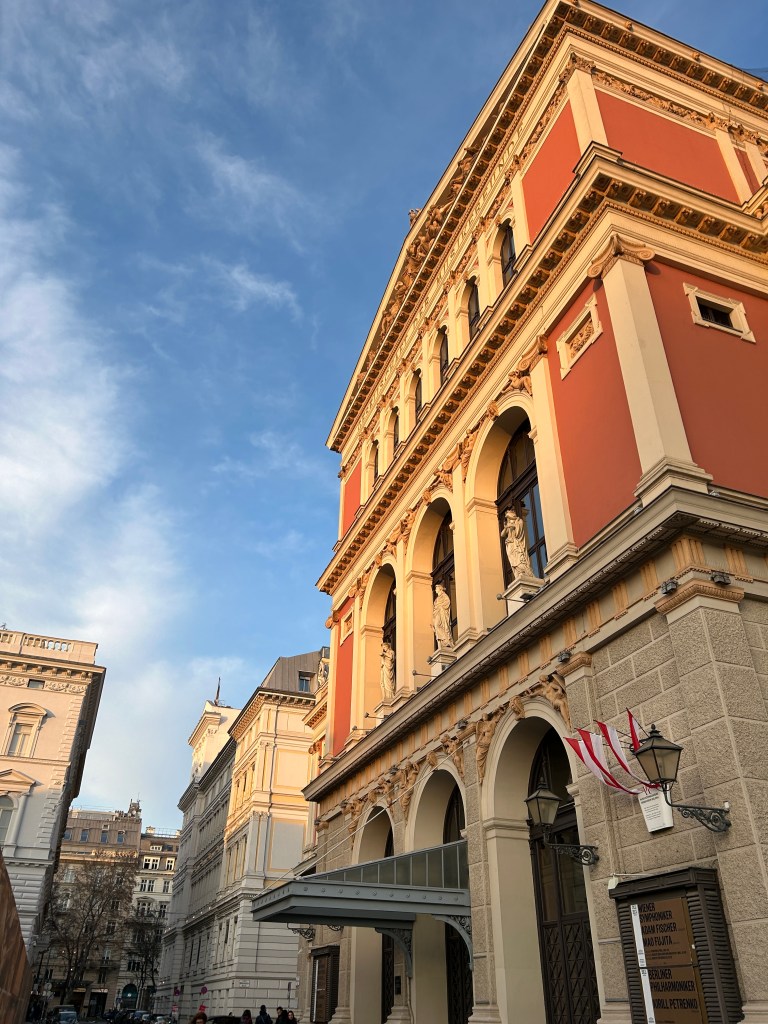
Pushing through delirium is what a vacation is all about, after all, I found out today. Eat for the first time in 6 hours or make the last window for the Albertina? The choice is obvious to me, especially in the face of impending accusations about how I spent my own time in Europe. Imagine living your life for yourself!! Fumbling through basic transactions is the best tempering medicine of all and the clerks at the Albertina were particularly skilled administrators. Ticket in hand, stupid Euro coin jammed into the locker door slot, and five ticket scans later, I’m finally getting cultured.

The expressionist exhibit of Herbet Boeckel’s work is a prime moment of why art interpretation feels meaningless until the work is in front of you directly. It’s all nice enough to look at but not really, actually. I couldn’t tell you if it’s too “produced” or if it’s lacking in context but it really made me feel an unease, even in the format of a beautiful plum branch watercolor.

However, continuing my sole walk through the museum (which feels like a show in and of itself with me and my American shame on full display), the presence of familiar names (my former neighbor in the Greenwood ground, Basquiat) and an algorithmic Spotify “impressionist” playlist ease the experience into a true learning moment. I collect new names and shapes and works that will never come up on a quiz (academic or socially) but that I’m rather lucky to have made acquaintances with. Maybe I’m not such an inward fucking airhead, I think, but I’m really reminded that living is, in fact, all about caring and I really do like to care.

Perhaps the best gift of all from the Albertina (save for my new ‘Modernist’ t-shirt which I will need to read a few books about before wearing) was a song by Philip Glass. “Floe”, as it’s called, is the kind of piece I wouldn’t come across without you, good for nearly nothing Spotify. Hormones balanced by a soggy, pink blended sauce oozing Schnitzel Döner oeuvre, I embark to the Danube (I will not pronounce it in front of you if you’re European) River.

Here is where the Baltimorean-turned-New Yorker really makes his buck, at least from my wallet. Wading through the stream of faces and sunglasses and always the goddamn Yankees Hats, the immutability of feeling is more apparent than in even my worst breakdown on a Bandon hotel room floor with my Dad. While I remember how nice a simple hand in my own feels and try to compartmentalize the fact that these are all people with desires and lives as mundane or exciting as my own, the Europeans are fast at work demonstrating that they’re better at love than us, too. Tongues down each other’s throats and eyes sewn shut, the reek of bins overflowing with tar and ash nor the oncoming Skoda that’s just hopped the curb right at them will not break them and their saliva apart. Glass can take at least 50% of the credit for making me tear, though these Viennese couples get to split the other half evenly.

I probably just really needed to eat.

Graffiti Glorification

Getting a shock factor reaction, especially in spaces where routine takes over the mind, is something that writers aim for. Amongst arguments around the individual originators of graffiti, whether in Philadelphia or New York, and the most coveted places, one place reigns above all: subway trains. If covering one panel of an MTA Subway car was a near impossibility in 2012, an entire M train sprayed and laid up at Metropolitan Avenue in 2020 seems only fitting. The accompanying recognition from train spotters and self-proclaimed “graffheads” being a relic of the 1980s and a gift to those who cry for “old New York.” 

 Like any artform, graffiti involves the artistic vision and expression of an individual or collaborators formed into a consumable form. Graffiti artists have considered themselves artists since inception, though their title hasn’t always been validated by the likes of Sotheby’s and SoHo galleries. Until the 21st century, graffiti was taken as a sign of urban decay by some and an indication of creative utilization by others. Now, graffiti’s ubiquitous presence in film and television and the creation of legal graffiti spaces speaks to the unfortunate efficacy of decades of broken windows rhetoric and the narrative of nostalgia, a view of the past that only remains evocative as long as it stays pasted. To create these narratives, on the screen and in the heads of city residents worldwide, graffiti artists have been shaped into street artists and contracted set artists in order to make their ends meet. 

The original pioneers of graffiti never expected any monetary gain from writing. Norman Mailer, for all of his misgivings in textual and marital form, put it best in his 1974 Allure Magazine feature on Uptown graffiti artists: “For now your name is over their name, over the subway manufacturer, the Transit Authority, the city administration. Your presence is on their presence, your alias hangs over their scene.” It’s never really been about pay. Notoriety, rather, is the currency with which writers trade, a form of geographical and risk averse clout that accompanies jumping into active and electrified Subway tracks. In the Marshall Berman edited anthology of what was once New York, “New York Calling,” Joseph Anastasio recalls the anonymous stardom that could follow a successful night in the trenches:

“I remember the 1980s, the good old days of New York, when each and every subway car bore an exterior top-to-bottom coating of layers upon layers of graffiti. I remember growing up and riding the subway a lot with my parents, and being inspired by all of this artwork. Graffiti looked and smelled a lot like being a rock star. If you did it good enough and got your name up enough, everyone in the city would know your name. When the book Subway Art came out back then, it put a public face on the movement. If having your name up all over town wasn’t Rock Star enough, getting your work in such a book sure did the trick. Part of me wanted to be a rock star. I’d never learn to play an instrument well enough, but I could draw damn good.”

And don’t you dare call these talents street artists, at least not to their face or to the writers of the 20th century. Street Art, as defined by the graffiti clean up tips and tricks website GraffitiActionHero.Org, is constructive, adorning the urban landscape, and is done with a smile! Big, bad graffiti, on the other hand, is destructive, accelerates so-called urban decay, and “was done with an outstretched finger,” presumably the middle one. While these Not-In-My-Backyard guidelines to graffiti eradication are entirely laughable, they also represent the aggression, disdain, and potential for crime that graffiti artists apparently carry in their bags. 

Promotional graffiti, on the other hand, exists with relative normalcy now. Contracted and composed by private businesses and city governments hoping to attract the attention of creative and, don’t forget, productive young people, graffiti or at least spray painted murals, if we’re splitting hairs, have come to represent a form of artificial city grit. The kind of grit that alludes to authenticity, an unchanged city, supposedly, that also allows the transplanted computer programmers or oil painters to create their own personal authenticity amongst the safety of a changed city. Now, before I am accused of vilifying city transplants(I am one myself, after all), I must clarify that the art forms and borough solidarity created around these expressions are cool! There is no harm in an audience who hasn’t lived, or even been in proximity of, graffitied infrastructure enjoying and growing to appreciate the artform. I applaud a well placed snippet of archival footage,  a window-to-window tagged 6 train approaching Zerega Avenue, just as I applaud those writers actually scaling the 180th Street Train Yard fence and continuing to write, most recently honoring the perished 2 train operator Garrett Goble. I just thought we were supposed to be scared of graffiti. 

At least, that’s how it was marketed to us by City Municipalities and Police Departments. In their journal article titled “Criminal but Beautiful: A Study on Graffiti and the Role of Value Judgments and Context in Perceiving Disorder,” Gabry Vanderveen and Gwen van Eijk both acknowledged and tested this spoon-fed rhetoric flaunted by leaders like Former New York City Mayors David Dinkins and Rudy Guilani and NYPD Police Commissioners Ray Kelly and William Bratton. “The broken windows theory suggests that graffiti and other signs of disorder in neighbourhoods cause not only fear but also crime, because fear would weaken social control and thus signal opportunities for crime to motivated offenders,” Vanderveen and van Eijk wrote, “We showed that underneath a fairly neutral attitude towards graffiti there is great variation in evaluations, both between and within people, which indeed demonstrates graffiti’s ‘interstitial’ nature.” Vanderveen and van Eijk shied away from taking bureaucratic rhetoric as a given and, in doing so, showed that graffiti is not presumed upon negatively and actually is subject to perception based on environment and aesthetic quality. Similarly, as graffiti writers of the 20th century are neutered and baffled by the public acceptance of street art over graffiti, Vanderveen and van Eijk confirm that this phenomenon is tangible: “A more lenient policy may signify awareness to different views on what public space should look like and who may legitimately contribute to and alter it, but it may also be embraced merely because some graffiti contributes to the marketing of cities as creative places.” And while these social changes driven by industry expansion wash in, the criminality of graffiti hasn’t been pulled out, keeping the nails in the coffin for now. 

“New York City subway graffiti died in May of 1989, when the last graffiti-covered subway cars were retired, replaced by trains with paint proof surfaces,” Claudia Barnett writes in her Studies in Popular Culture journal article, “The mayors and the masses simply wanted to see it disappear.” It wasn’t just broken windows policing, felony sentencing, and paint proofing that killed graffiti, however. To Barnett, galleries aided in the process of commodifying graffiti, speculatively in order to keep the subversion of graffiti to a minimum. “While the painted picture may appear similar, the experience, in the processes of painting and of viewing, has been profoundly altered,” Barnett rightfully complains, “Graffiti has changed from a vision to be looked at to an object to be consumed.” Curiously, this distinction of public and private spaces defining the validity of graffiti continues today, only a literal big screen. 

The Get Down, 20th Century Women, and other 21st century renditions of the 20th century undoubtedly use graffiti as a signifier of the era. Enough time has passed that even the most fearful of Baby Boomers and Generation X’ers can look back at the era of graffiti from the current safe haven of a graffiti-less society, one where a tag may last 24 hours at best. In fact, the sight of fictional or digitally created graffiti may even elicit a story or two from Mom’s years of living in Park Slope before it was, well, Park Slope: “Nobody even took the F train into Brooklyn back then!” To create this illusion in a graffiti adverse society, however, requires the expertise of a writer from back then. Enter the graffiti consultant, a Netflix paid position on The Get Down held by John ‘Crash’ Matos and Chris ‘Daze’ Ellis. If any show needed to get it proper, The Get Down couldn’t be phony under the highest of Bronx standards. Interviewed for the BET Style section, Crash and Daze said, “This amazes me that our influence and inspiration has gone on a global level.” The show’s graffiti and the appearance of the writers in the show are directly influenced by Crash and Daze, the kind of acknowledgement and payment that wasn’t even considered when they started writing 30 years ago. 

Crash and Daze aren’t the only writers to cash checks. In fact, almost two dozen current New York City graffiti artists are set to split 6.75 million dollars in settlements after their art was demolished along with the structure carrying it. Known as 5Pointz, the former Neptune Meter factory in Long Island City, Queens became a haven for graffiti artists after building owner and developer Jerry Wolkof began allowing tagging and painting to occur in the abandoned buildings, according to Gothamist. In the time since, Wolkof has died but not before demolishing the 5Pointz structure at 45-46 Davis Street, at least 20 graffiti artists work going with it. While it was commonplace for other writers to paint over each other’s work at 5Pointz, they were always allowed to document it before it was gone. Demolition, on the other hand, gave them no warning. “Unhappy with losing their work, a group of artists filed a lawsuit against Wolkof’s development company G&M Realty, alleging their rights under the Visual Artists Rights Act (VARA) had been violated,” an article in ArchPaper states,“Under VARA, the plaintiffs argued, their work was protected against willful “destruction of a work of recognized stature, and any intentional or grossly negligent destruction of that work is a violation of that right.” In October, this claim was affirmed by the Supreme Court, meaning these writers are each owed thousands of dollars. 

Even so, and I’m sure this payout is appreciated, writers will continue to write whether they get a check or not. As the pandemic continues and the MTA faulters, writers get up more often, as depicted on Instagram accounts like @NYCGRAFF.HEAD. Retired stainless steel R32 train cars become akin to the box trucks sitting in Westside Highway traffic and the occasional J or M train rolls through stations, dripping paint enroute to the wash. There are no silver linings to the current time but a painted train is a nice thing to look at, a welcome change of pace.

Waving Goodbye to Delicioso Coco Helado

Just south of 161st street on St. Anns Avenue in The Bronx, a strip lined with sidewalk mechanics and the accompanying Napa Auto Parts store, is Delicioso Coco Helado headquarters. Founded by Honduran immigrant Alfredo Thiebaud, the building’s red brick wall is clothed in a livery of tropical fruits, jackfruit and papaya included, that have been cracked and diced into various forms. Their headquarters and dispatch unit,  home to 3 gallon tubs of helado, is hardly noticeable. The real treasure lies in the hands of the scooper. 

Rolling a stainless steel, 4 drum cart around, Delicioso Coco Helado puts up a fight against the corporate giants, with synchronization starting at the Green and White cart umbrellas and continuing to the fruit flavor depicting serving cups. Whether at the corner of 175th Street and Wadsworth Ave in Washington Heights or 41st Street and 5th Avenue in Brooklyn, my two frequent stops, the imagery and experience remain the same. That’s a good thing. 

And while the company prints an extensive flavor list(17 flavors that are available at wholesale in store), the rotation of flavors rarely changes. Coconut, Cherry/Mango, and Rainbow always populate 3 drums with Tamarind and Pineapple/Lemon interchanging in the 4th. I will always order Cherry with Coconut and the purveyor will always pack the fruity flavor on top of the coconut. These are standard procedures. 

The allure is the texture. While the flavors are vague and all coconut laced, a frozen, sandy, tomato paste consistency is present in each flavor. It’s more of a lick and less of a bite. These carts exist to aid in instant refreshment, a stick-less and spoon-less refreshment that happens upon you.To reject any supports or utensils is to make this a summer exclusive and is a testament to the consistency of the frozen and packed cream. The coconut flavored cream must be extracted through a crush of the cup and a suck of the gut, requiring comfort and confidence in oneself to be eaten in public. 

The publicity of eating a $1.50 to $2.50 cup of soon-to-be melting cream is unavoidable, however, because, even in a pre-pandemic world, you can’t stop in anywhere for your fix. Delicioso Coco Helado claims to dispatch carts across The Bronx, Manhattan, Queens, and Brooklyn but I don’t seem to see them on 14th Street. They may roam the boundaries of University Row, the straight shot from Washington Square Park across 8th Street/St. Marks into Tompkins Square Park, but, in a square mile dominated by the hyper visual Blue Bunny bodega bins and naturopath imitators like Van Leeuwen, what’s the point? The cart pushers and purveyors of this coconut cream are, of course, smart and cater to their customer.

Instead of jostling for storefront property, the carts are most frequently found on small park paths and rolling but tame avenues from Kingsbridge across to Jackson Heights and into Weeksville. Sure, the carts do stand on street corners and, yes, you could seek after one but to do so would rush the process. Hiking up Amsterdam, the twin bell chime is supposed to slow you down and speed up the toddler sized feet that will soon swarm around you. And because the carts seek you out, they become unavoidable as the temperatures rise. On my mission to Delicioso HQ, leaving Sunset Park and emerging in the South Bronx, each subway exit began with the ding of a bell and the shade of a Delicioso Coco Helado umbrella. With sleeves being covered and zippers rising, the annual season for coconut ice will end on October 31st, tomorrow. Until then, I recommend the $2.50 cup. And don’t ask for a spoon!

Motorcyclists Without Motorcycles

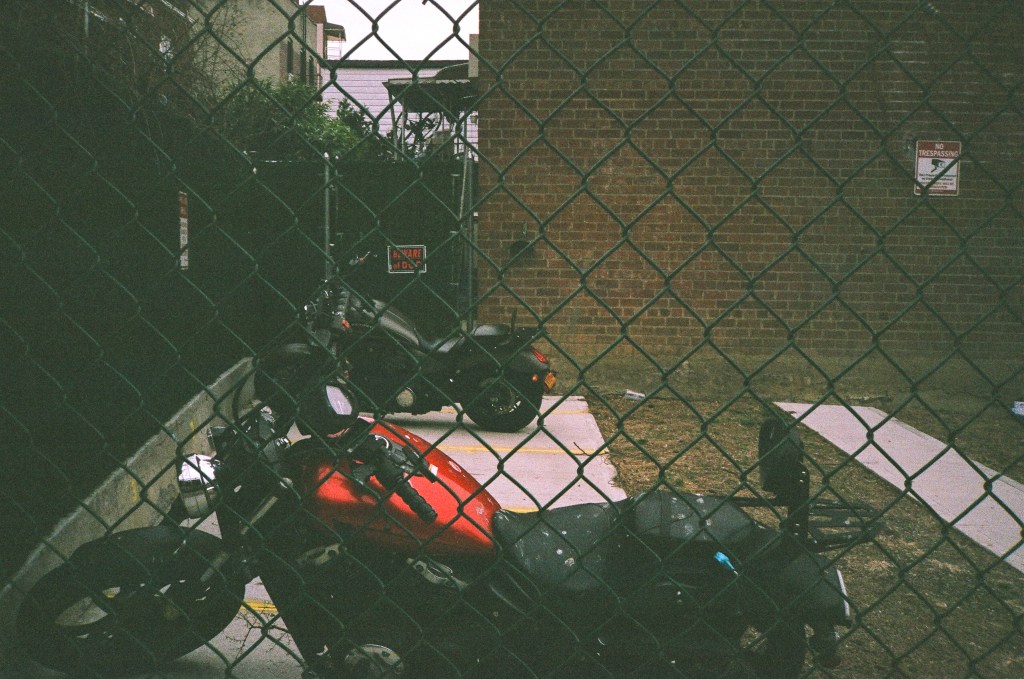
Yes, you, with the bumble bee perforated leather DUCATI jacket at the 2nd Avenue F train station: why aren’t you above ground and on your Scrambler? Perhaps you rode your GSXR to the St. George Ferry Terminal, but that D-30 back protector can not make the waist hugging, shoulder puffing SUZUKI one piece any more comfortable nor any less stylish. Similarly, while period-correct behind the bars of Honda Hawk GT650, I know the perforation from shoulder to wrist on that seemingly custom stoney white, asymmetrically pinstriped jacket isn’t doing you any temperate favors on the Downtown N train.

It is not my paid profession or my earned place to make consultant style trend judgements in the world of Fashion. I am not ​Chris Black​! Telling people what they can and cannot wear is not a qualification I-or really anyone-fit. But, from the standpoint of comfortability, the weight of a multi-millimeter thick leather jacket isn’t a wearable workout,but rather a stocky, squeaking, and unruly molded animal skin. The spine fracture preventative padding digs into your skin and unflatteringly stretches the exterior of the jacket, creating what would be otherwise concerning lumps, and, even if you remove the figure misconstruing protection, the mesh inner lining strangles your pores into a perspiration-steeped mess. I can confidently say that the lightning bolt patterned black and grey leather Harley Davidson jacket is uncomfortable in line at the Williamsburg Whole Foods. Form over function it is.

For the most devout riders, however, the necessity of function over form isn’t so much as a semi-conscious stacking of the statistical odds but a creed to live by. I’m not here to preach the hymn of all-the-gear-all-the time or to dictate what precautions individuals who ride should take. While I, having been properly influenced by my employment at Union Garage, am a subscriber to an amended version of All-The-Gear-All-The-Time—simply add ‘Almost’ before ‘all’—and numerous ​studies ​verify safety gear’s protective vitality, it is truly upon the rider to make a choice with their survival at the center. In addition to the parable of ATGATT, the vocabulary of a road weathered motorcyclist will dutifully include “dress for the slide, not the ride.” To keep your nervous system intact and your skeleton properly aligned in said slide(it’s not a matter of if you crash but when you crash)a DOT or SNELL approved full-face helmet(to keep your brain synapses communicating), a leather or textile jacket with CE rated armor(skin grafting and casts are expensive and painful), riding specific jeans with kevlar sewn into the “crash areas”(see skin grafting again), boots with a stiff toe and bolstered ankle(Dr. Martens will burn, slip, and still let your ankle shatter), and knuckle reinforced gloves should suffice. For a group so supposedly steeped in thrilling adventure and a nonchalant coolness, the potential for catastrophe seems to cycle through the devoted rider’s psyche almost too frequently.

Let it be known; the proliferation of Harley Davidson apparel is not personally offensive- I have no particular affinity, an ambiguity really, towards the brand-and is not surprising, seeing as the fervent domestic patriotism of Harley’s hit-the-open-road marketing has been part of what keeps them in business. And that is exactly why sleeveless, belly button adjacent Harley Davidson t-shirts have become a staple in the closet of metropolis bound tweens, teens, and twenty-somes: the shirt, or really the brand behind the shirt, represents the lingering impossibility of carrying out their “Easy Rider” fantasties. In the case of these altered and revived garments, the wearer is no longer the AARP eligible man with the $23,199 custom colored Street Glide but, more often than not, a young, unapologetic woman. Instead of being relegated to their backs pressed against the sissy bar, they are the ones behind the handlebars twisting the throttle.

Those who claim “It’s like wearing a jersey or another brand,” have fixated on the visual imagery of a significant team over the tangible function a competition-weight rawhide jacket provides. A brand or a sports team is a cultural unifier, an image to rally behind and often in collective form, a motorcycle is solely something to be ridden on and operated. The barely ridden but deeply invested motorcyclist in me wants to wax poetically that a motorcycle is a machine requiring respect, a learning curve, and taming: an assertion that implies anyone without the experience of being on a motorcycle is in the outgroup. Anyone who has dumped a motorcycle(I have, sorry Gabe!) will assuredly agree that what I waxed on is true: your mortality is never more present behind the bars of your crotch-propelling machine. And perhaps this is why motorcyclists are so vehemently attached to their preferred method of transportation, and why they willingly out anyone without first hand experience, especially those who feign having felt that coccyx pulling acceleration.

In the same way that true motorcycle gear is uncomfortable as daily attire, garments designed with the intention of looking but not being rideable serve no more purpose than an interchangeable cotton Gildan hoodie or Asos pleather zip-up. Take Ducati’s collaboration with Tasmania born boot company Blundstone: with a splash of yellow elastic and an aptly placed shift collar, the admittedly rugged but slip-on leather boots are touted as the line between safety and style while upon a Ducati Scrambler. Moving at a respectable pace, but certainly not at a full clip with only 803ccs of inline twin power available, down the New England Thruway on a hazy and sweltering July day, the varyingly paved and undulating 180 degree entrance ramp to the Hutchinson River Parkway(after all, cutting across the Bronx and through Queens is the less congested way to Williamsburg) forces a refocusing of your eyes far ahead of where you instinctively look. As you apply pressure to your right hand(buzzword: countersteering)and initiate the lean angle needed to carry you through all 180 degrees, the descending change in paving type shifts weight forward, folding the sidewall of the front tire and forcing your body onto the ground, and into the air your slip-on Blundstones go. There are infinite numbers of anti-safety safety products, always at the wish of further aestheticization.

I’m left with the question of why, when the genuinely protective gear is cumbersome and the aestheticized versions lack any protection or cultural merit, do non-riders wear it at all? The answer is obvious, to some extent, that the symbolism of speed and intentional risk taking projects as cool. And because it is purely about the symbolism of motorcycling, the motorcycle itself becomes antithetical to the look.The wearer of motorcycle gear, in its clasping leather or zipping waxed cotton forms, seeks to invoke the idea that they ride, or that they could. The fabled rush of wind through one’s hair(the wind actually pummels your chest and kneecaps)is the desired aesthetic output by the look. With that look, naturally, comes the voluntary operation of the machine itself, but the weight of a two fingered clutch pull or the metallic snick accompanied by a precise upshift are not the actions romanticized. In all likelihood, the actual operation of the bike itself isn’t of interest to the imposter motorcyclist.

And that’s ok. For the metropolis-bound private art school educated sculptor and the City College of New York graduated civil engineer alike, any means of privatized, motorized, rapid transit is a far fetched aspiration. Relegated to the positively efficient but shoulder to shoulder experience of public transportation, these working people’s transportation fantasies and realities diverge at the payment point of their daily multi-dollar fare. In cities large enough and with appropriately distributed subsidies to enjoy a generally well functioning public transit system, the motorcycle becomes for many a fantasy of self indulgent pleasure, and an induction into a socially rejected but tightly interlinked out-group. Who am I to deny them the dream, especially when I share it?

Return to the Subway

IMG_5599

The longer you commute, the better your Subway eyes get. Having spent hours of each day in and out of 20th-century tunnels, the indiscernible but impending darkness(which sounds like a Raymond Carver characterization)becomes individual pieces of rail, graffiti tags from 164th Street, and an occasional vested MTA worker.  My Subway eyes are dilated at the moment.

The system feels sad. The Subway has always been a sad place, from overworked nurses to the shelterless, but riding now lacks even the excitement at the end of every ride: a  positive destination. With a wink and a doors-closing chime, the G train conductor holds hope.

IMG_5549

“Mindless Flavorless Objects” by Emmet White

One of my many indulgences, blogged and in the open.

Jamie Lauren Keiles's avatar

Sitting on-top of L.L. Bean flannel covers, the Andrea Arnold directed season of Big Little Lies playing, the crumbs from a sleeve of unsalted Premium saltines rest in between my comforter and mattress. I am not alone, as they say, in this uncomfortability or this indulgence. And there is, of course, a market for this indulgence. 

Lundberg rice cakes, the pinnacle of this food group, are followed by the likes of unsalted Premium Saltines, Original flavored Goldfish, Kim’s Magic Pop, Cheerios, water crackers, and any other (essentially) flavorless square, circle, or triangle shaped carb. General Mills, Nabisco, and Pepperidge Farm produce iterations of these desired snacks, typically artificially flavored and well salted, in undesirable varieties. With no flavor, airy textures, and of varying geometric and non-geometric shapes, this food group bears no nutritional value or palatable appeal. While, in all likelihood, these healthier versions were created for dieting, the methodology…

View original post 386 more words